
The short answer
If your furnace blows cool air, short-cycles, makes new noises, or won't ignite, it likely needs repair, and many of these problems come down to a single failed part. We diagnose the whole system before recommending anything. Bay Area Air District rules don't require you to replace a furnace that still works.
San Jose winters are mild compared to much of the country, but damp, chilly nights still make a working furnace important. When your furnace quits, keeps cycling on and off, or starts making a noise it didn't make last year, you want a clear answer about what's wrong and what it will take to fix it. PerfectFix HVAC Services repairs gas furnaces in homes across San Jose and nearby cities, including Santa Clara, Campbell, Milpitas, Cupertino, and Los Gatos. This page covers the warning signs worth acting on, what our technicians check during a repair visit, how to weigh repair against replacement under the Bay Area's changing appliance rules, and what affects the cost of a fix.
Signs Your Furnace Needs Repair
Furnaces usually give some warning before they fail completely. Catching a problem early can mean a simpler repair and fewer cold nights. Call for service if you notice any of the following:
A light dusty smell for the first few minutes of the season's first run is normal, because dust is burning off the heat exchanger. A smell that lingers or gets stronger is not normal. If you ever smell gas (a rotten-egg odor), leave the house right away. Don't flip light switches or use anything that could spark, and call your gas utility or 911 from outside. If your carbon monoxide alarm goes off, get everyone out and call 911. Don't restart the furnace until it has been checked.
- No heat at all, or air from the vents that stays lukewarm after the burners have been running for a while
- The furnace turns on and off every few minutes without warming the house (short-cycling)
- Some rooms stay cold while others are comfortable
- Banging or booming at startup, or squealing, scraping, or rattling that's new
- The igniter clicks or glows, but the burners don't light or they shut off after a few seconds
- The blower runs constantly or won't shut off
- The thermostat calls for heat, but nothing happens
- The furnace locks out and has to be reset, or it keeps tripping a breaker
- Water pooling around a high-efficiency furnace
What We Check During a Furnace Repair
We diagnose before we recommend. A furnace that won't heat might have a dirty flame sensor, a failed igniter, a blocked vent, or a control board problem. Guessing wastes your time and money. Our technicians work through the system in order:
Once we find the cause, we explain it in plain language. When we can, we show you the worn or failed part. If we spot anything else that could cause trouble soon, we tell you, and you decide what to do about it.
- Thermostat settings, wiring, and batteries, and whether it is calling for heat correctly
- Air filter condition and airflow through the return and supply sides
- Ignition system, including the hot surface igniter or spark igniter and the flame sensor
- Gas valve operation and burner condition
- Inducer motor, pressure switch, and venting, looking for blockages or disconnected pipe
- Heat exchanger, inspected for visible cracks, corrosion, or signs of overheating
- Blower motor, capacitor, and blower wheel
- Limit switches and other safety controls
- Control board error codes and electrical connections
- Condensate drain and trap on high-efficiency furnaces
- Carbon monoxide levels around the furnace after it's running
Repair or Replace: Weighing Your Options
Many furnace problems can be fixed by replacing one component, such as an igniter, flame sensor, pressure switch, capacitor, or inducer motor. In those cases, a repair is usually the sensible choice. Replacement is worth discussing when the heat exchanger is cracked, when the furnace needs several major parts at once, when it has needed repeated repairs, or when it's older and parts are getting hard to find. We'll lay out both options and let you decide.
Local rules are part of this decision. Bay Area Air District appliance rules do not require you to replace working equipment. They apply only when an existing furnace fails or is replaced. Under Rule 9-4, natural gas furnaces manufactured from 2029 must meet a zero-NOx emission standard. In practice, that points homeowners toward heat pumps for furnace replacements after that date. If your furnace can be repaired, fixing it keeps your options open. If you're replacing it now, compare a new gas furnace with a heat pump before you choose.
The Santa Clara Valley's mild, damp winters suit heat pumps well. Inland and southern parts of the valley also get noticeably hot in summer, so a system that both heats and cools can make sense. On incentives: the federal Energy Efficient Home Improvement Credit (25C) applied only to qualifying heat pumps placed in service before December 31, 2025. It isn't available for new installations after that date. You can check BayREN and your local clean energy provider for current heat pump and electrification incentives. Amounts and availability change with each funding cycle, so we confirm the current offer before we include it in a quote.
What Affects the Cost of Furnace Repair
Every repair is different, so we don't quote a fix until we know what's wrong. These are the factors that make the biggest difference:
Before any work begins, we tell you what the repair involves and what it will cost. Nothing gets done without your approval.
- Which part failed, and whether it's a common part or specific to your furnace's manufacturer
- Part availability, especially for older or discontinued models
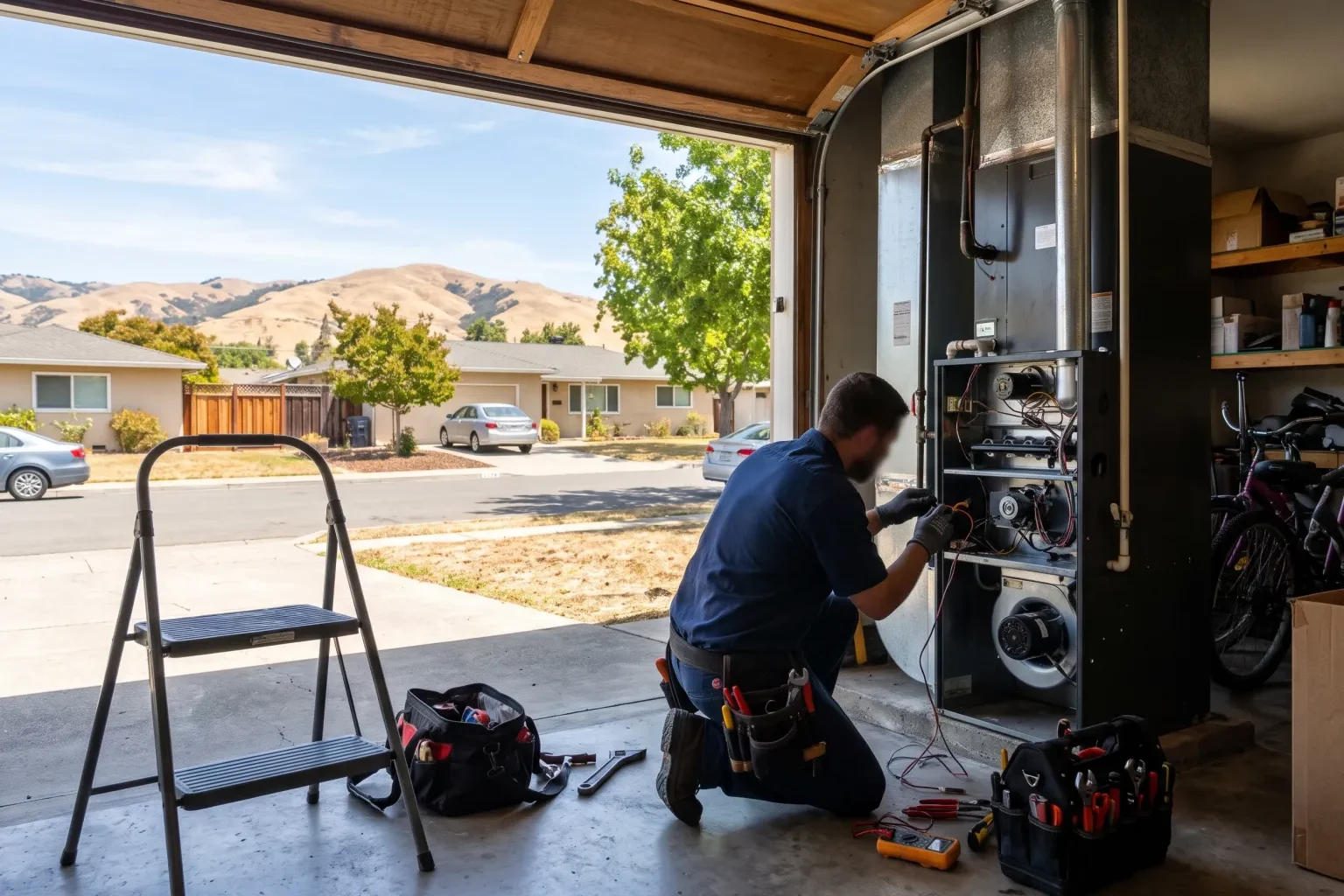
- Where the furnace is installed, such as an attic, crawlspace, closet, or garage, and how easy it is to reach
- How long the diagnosis takes, since intermittent problems can take longer to track down
- Whether more than one component has failed
- The type of furnace: standard or high-efficiency condensing, and single-stage, two-stage, or variable-speed
- Venting, drain, or ductwork problems found during the visit
How a Furnace Repair Visit Works
When you contact us, we'll ask what you're noticing: the sounds, smells, and timing, and whether the furnace runs at all. If your furnace has a small window on the control panel, note any blinking light pattern. That error code can point us in the right direction. Before we arrive, clear a path to the furnace and keep pets out of the work area.
At your home, the technician talks with you first, then inspects and tests the system as described above. Once we've found the problem, we explain the cause, give you your repair options and the cost, and answer your questions. After you approve the work, we make the repair. Then we run the furnace through full heating cycles to confirm it ignites, heats, and shuts off properly. Before we leave, we go over what we did and share anything we'd recommend you keep an eye on.
Furnace Repair by city
- Furnace Repair in Campbell
- Furnace Repair in Santa Clara
- Furnace Repair in Los Gatos
- Furnace Repair in Milpitas
- Furnace Repair in Monte Sereno
- Furnace Repair in Saratoga
- Furnace Repair in Cupertino
- Furnace Repair in Sunnyvale
- Furnace Repair in Fremont
- Furnace Repair in Mountain View
- Furnace Repair in Los Altos
- Furnace Repair in Los Altos Hills